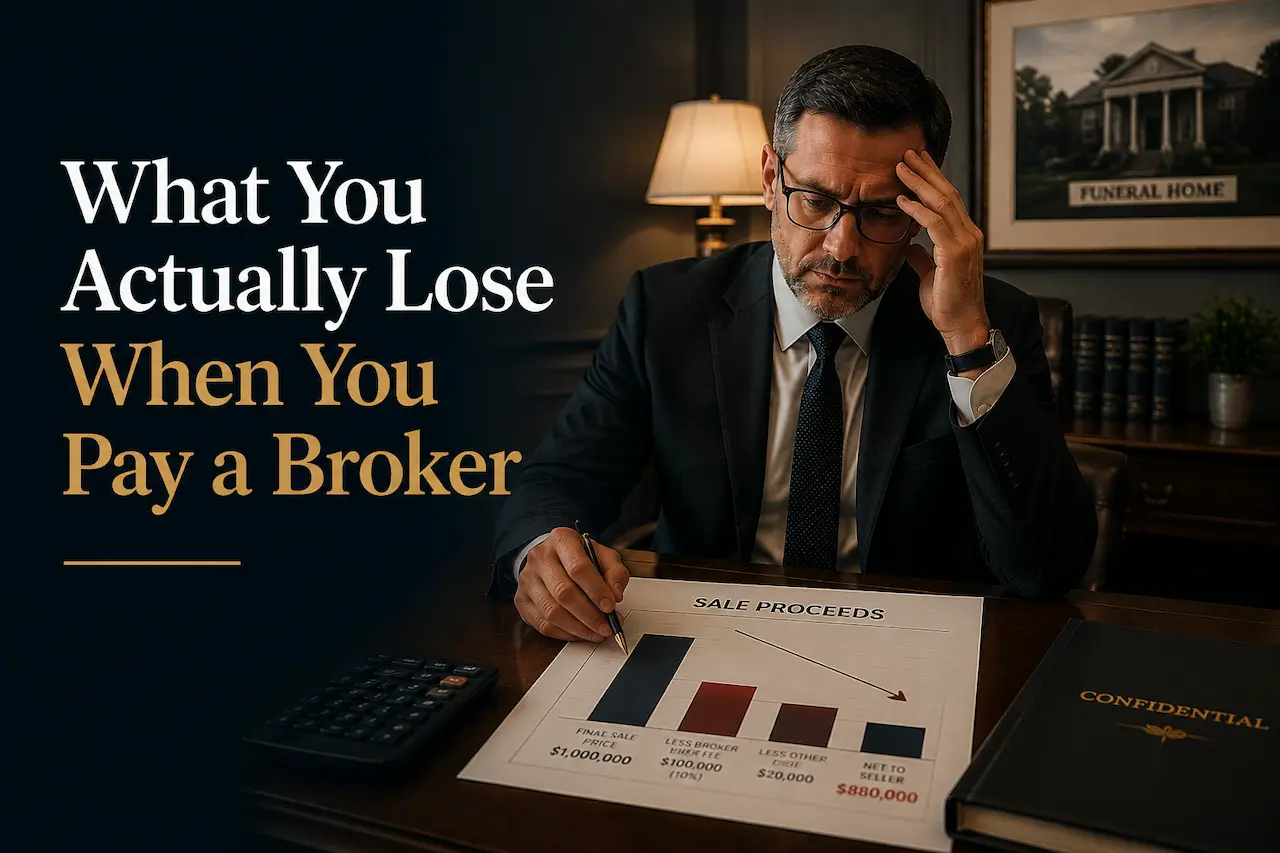
Most owners look at a broker commission and see a single percentage. What they miss is everything else that quietly leaves with that fee.
We have helped owners compare both routes side by side, and the real cost of a broker is almost always larger than the headline number. I have seen firsthand what owners give up beyond the commission, and this guide lays it out plainly.
The Commission Is Only the Beginning
The most obvious cost is the commission itself, often a significant percentage of your entire sale price. On a meaningful transaction, that figure can reach six figures taken straight from your proceeds.
But the commission is just the entry point. Owners frequently overlook additional charges layered on top: marketing fees, administrative costs, and in some cases a retainer paid whether or not the business ever sells. Each of these chips away at what you walk away with, and together they can quietly add tens of thousands to the true cost. To see how this compares to keeping the sale in your own hands, our guide on selling without a broker breaks down the difference in real terms.
What makes these costs sting is that they are often presented as routine, buried in a listing agreement most owners skim rather than scrutinise. The visible commission, though, is not even the most expensive thing you lose.
You Lose Control of Your Price
A broker is motivated to close a deal, and a quick close sometimes matters more to them than your maximum price. That misalignment can quietly cost you.
Some brokers inflate the asking price to win your listing, then pressure you to accept lower offers when the inflated number fails to attract buyers. The damage shows up in two ways:
- An overpriced listing that sits too long and signals trouble to buyers
- Pressure to accept a discount later, after momentum is already lost
There is a deeper issue here too. A broker earning a percentage has little incentive to fight for the last increment of value because the difference to their commission is small while the difference to your proceeds is large. The few thousand dollars of commission they might gain by holding out is rarely worth their effort, even though it could mean far more to you. I always advise owners to question any valuation that feels designed to flatter rather than inform. Your price should be defensible, not a tool to secure someone else’s commission.
A defensible valuation is what protects you here, because it removes the guesswork a broker can exploit. Our funeral home valuation guide shows how that number is built on real earnings rather than a figure designed to win a listing. Losing control of price is costly, but losing control of privacy can be worse.
You Lose Control of Confidentiality
In this profession, discretion is everything. When your sale runs through a broker’s listing and outreach, you have less control over who learns about it and how.
Wider exposure raises the risk that families, staff, or competitors discover the sale before you are ready. That can soften referrals and unsettle your team at the worst possible moment. The broader a listing is circulated, the more hands your information passes through, and every additional contact is another chance for word to escape. A direct, controlled process keeps confidentiality in your hands, which protects both your reputation and your leverage at the table.
The financial consequence of a leak is real, not abstract. A business that appears unstable because news got out is worth less, which means a confidentiality slip can cost you far more than any commission ever would. Beyond price and privacy, there is a quieter loss most owners never see coming.
You Lose the Owner-to-Owner Connection
A funeral home sale is personal. Buyers want to understand the legacy, the community standing, and the relationships behind the business, and that story is best told by you.
When a broker sits between you and the buyer, that direct connection is diluted. The nuance that makes your home valuable, decades of trust and reputation, can get flattened into a listing sheet. A buyer who only sees numbers on a page has no reason to pay for the goodwill behind them, because no one has shown them why it matters. We prioritise keeping owners close to the conversation, because the human element often justifies a stronger price than any document can.
This connection also builds trust that smooths the entire transaction. A buyer who has spoken directly with the owner, heard the history, and understood the standard of care moves through diligence with more confidence and fewer second thoughts. Once you add up commission, price erosion, privacy risk, and lost connection, the true cost becomes clear.
When a Broker Might Still Make Sense
Honesty matters here, so it is worth saying that a broker is not always the wrong choice. For some owners, the value a broker adds can outweigh the cost.
If you have no time to manage the process, no network of potential buyers, and no appetite for the work involved, a broker can fill those gaps. The key is to enter that arrangement with eyes open, understanding exactly what you are paying and what you are giving up in price, privacy, and control. The mistake is not using a broker; it is defaulting to one without comparing the alternative. When you weigh both routes honestly, you can decide based on your real situation rather than assumptions.
That comparison is exactly what protects your proceeds, whichever path you choose. If you want to weigh your options honestly, our team is ready to help you take the next step.
Conclusion
A broker’s cost is far more than a commission. You can lose control of your price, your confidentiality, and the personal connection that gives your home its value. Once you see the full picture, the choice deserves real thought rather than a default. We are here to help you keep what you have earned.
Why Choose Us
We focus exclusively on funeral home owners, and our founder Matt brings firsthand understanding of this profession to every sale we guide.
- Deep specialization in funeral home sales, not general business brokerage
- A direct approach that protects your proceeds from heavy commissions
- A confidential process that keeps you in control of your privacy
- Honest, defensible valuations grounded in your real earnings
- Owner-to-owner guidance that preserves your legacy and leverage
FAQ
1. How much does a funeral home broker cost?
Brokers typically charge a commission that is a significant percentage of the sale price, often reaching six figures, plus potential additional fees on top.
2. Are there hidden costs beyond the commission?
Yes. You can lose value through inflated pricing, pressure to accept low offers, reduced confidentiality, and a weaker direct connection with the buyer.
3. Why would a broker inflate my asking price?
An inflated number can win your listing, but it often leads to a stale listing and later pressure to accept a discount, costing you in the end.
4. Does a broker protect my confidentiality?
Broker-led outreach usually means wider exposure, which raises the risk that staff, families, or competitors learn of the sale before you are ready.
5. Is selling without a broker a realistic option?
Yes. Many owners sell directly with proper preparation, keeping more of their proceeds and retaining full control of price and privacy.